Dubai’s real estate market continues to evolve, offering lucrative opportunities for strategic investors.
March 11, 2026
Once dismissed as a mirage city built on ambition and sand, Dubai has quietly matured into one of the world’s most coveted ultra-prime real estate destinations — a place where waterfront palaces sell before the foundations are poured, and where global capital flows not out of necessity, but out of desire.
The numbers tell a story that even the most sceptical investor would struggle to ignore. In 2025, Dubai’s residential market recorded over AED 520 billion in total transaction value — a figure that would have seemed fantastical just five years ago. Yet behind the statistics lies something less quantifiable: a fundamental shift in how the world’s ultra-wealthy think about property, geography, and belonging.
For years, London, Monaco, and Singapore held unchallenged dominance as the safe harbours of private wealth. Dubai, for all its spectacle, was considered a secondary destination — a place to park capital, not build a life. That perception has been dismantled with remarkable speed.
The Anatomy of Demand
The buyer profile in today’s Dubai market reads like a global ambassador’s guest list. Russian oligarchs arrived first in the post-2022 wave, followed swiftly by Indian tech founders, British financiers seeking residency flexibility, and — perhaps most significantly — a growing cohort of American buyers who once would never have considered the Gulf as a serious residential option.
“We used to see Dubai as a second home market,” notes one private wealth advisor at a leading Geneva-based family office. “Now clients are asking whether it should be their first.” The shift is partly tax-driven — the UAE’s zero income tax and zero capital gains regime is an undeniable structural advantage — but analysts caution that attributing the entire boom to fiscal arbitrage alone misses the point.
The modern buyer isn’t escaping something. They’re choosing something. And what Dubai offers — infrastructure, safety, climate, connectivity — has become genuinely competitive with anywhere on earth.
Where the Ultra-Wealthy Are Buying
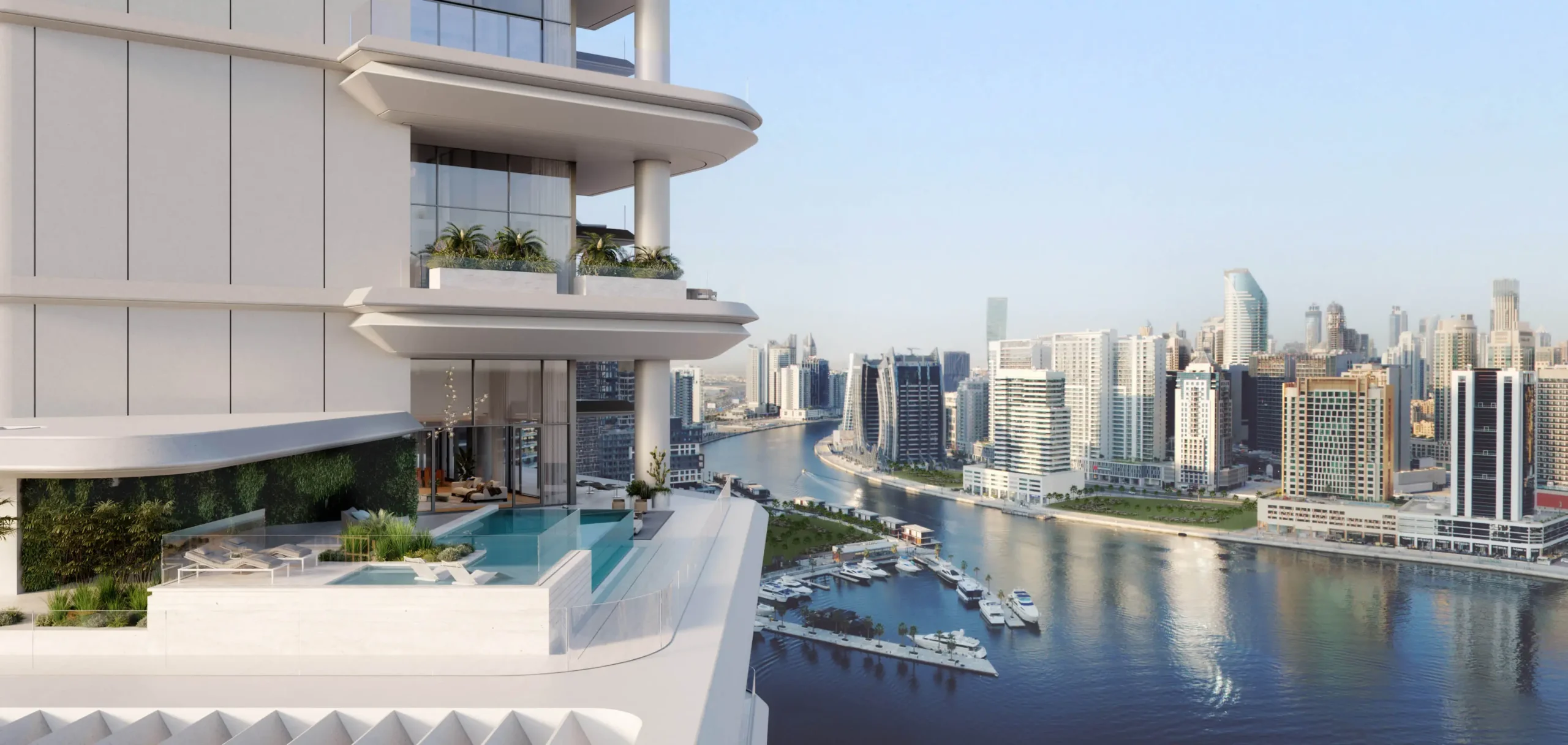
Palm Jumeirah remains the address of record for those who require both spectacle and scarcity. Frond G and Frond M continue to command the highest per-square-foot premiums in the emirate, with signature villas trading at figures that would embarrass comparable waterfront on the Côte d’Azur. Yet the savvier allocators have begun looking beyond the Palm’s well-worn trophy appeal.
Mohammed Bin Rashid City has emerged as the neighbourhood of choice for buyers who want the prestige of proximity to Downtown without its density. Sobha Hartland II has generated a waiting list that development insiders describe as “humbling.” Meanwhile, Jumeirah Bay Island — accessible only by a single causeway bridge — has attracted the kind of attention that only truly exclusive addresses command.
For those who find the mainland too urban and the established islands too familiar, the under-the-radar play remains the northern emirates. Ras Al Khaimah’s coastal estates and Sharjah’s newer waterfront districts offer land scarcity that has yet to be fully priced in — what several analysts describe as “2019 Dubai valuations.”
The Off-Plan Paradox
Perhaps no aspect of Dubai’s market confounds outside observers more than the off-plan phenomenon. In most mature markets, buying a property that does not yet exist carries a risk premium. In Dubai, it carries the opposite: a scarcity premium. Developers routinely report that flagship projects sell out within hours of launch, with buyers submitting expressions of interest before floor plans are even public.
The dynamic is partly structural. UAE residency visa reforms — the ten-year Golden Visa, available to property investors above AED 2 million — have created a powerful incentive to establish a formal asset footprint in the country. For a buyer intending to hold for three to five years regardless, the off-plan model offers one additional advantage: phased payment structures that allow capital to remain deployed elsewhere during the construction period.
In a city building its next chapter in real time, the address that doesn’t exist today may be the most prestigious postcode of 2028. That’s not speculation. That’s Dubai’s fundamental value proposition.
Risk, Reality, and the Long View
No honest assessment of Dubai real estate can ignore the market’s historic volatility. The post-2008 correction erased 60% of values in some submarkets. The 2014–2019 downturn tested the patience of even the most committed long-term holders. Those episodes have not been forgotten by institutional capital, which continues to approach the market with a blend of enthusiasm and discipline.
What has changed is the depth and diversity of demand. The market of 2026 is not the speculative frenzy of 2007, when overleveraged investors were flipping off-plan contracts in parking lots. Today’s primary buyer is capitalised, internationally mobile, and frequently purchasing with minimal or no debt. That structural shift — from leverage-driven speculation to equity-backed lifestyle allocation — has fundamentally altered the market’s risk profile.
Supply remains the variable that keeps analysts cautious. Approximately 85,000 new residential units are scheduled for delivery between 2026 and 2028, a number that will test absorption capacity, particularly in the mid-market segment. Ultra-prime faces a different dynamic: land supply on the best waterfront addresses is genuinely finite, and Dubai’s government has shown no appetite to dilute the scarcity that sustains premium pricing.
The New Permanence
What strikes the careful observer most is not the scale of Dubai’s ambition — that has always been present — but the growing sense of permanence. The city’s population is no longer predominantly transient. Schools are filling with children whose parents have chosen Dubai as a generational home. Business networks have deepened into genuine civic infrastructure. The restaurants, galleries, and cultural institutions that once felt like imported transplants have begun to develop a genuine local character.
Real estate, in its most fundamental form, is always a bet on a city’s future. For a growing number of the world’s most mobile and discerning buyers, Dubai’s future no longer requires a leap of faith. It is simply — and with increasing conviction — where they want to be.